Wednesday, 16 May 2012

Beatties cement glue

While searching through some boxes of odds and sods, in fact trying to find the rubber stamp characters for the Chalk Cliddesden sign created in the previous post. I came across some Beatties Cement Glue, still with some left in it (but not yet tried/ used). Anyway made me chuckle, and reminded me of my early modelling days. Surely this is an Antique? like the plastic bags reported else where in the blog-o-sphere: phils workbench. Sure it's probably not as old but still a contender...


Ed

Sunday, 6 May 2012

Chalk and Pens

Chalk

The station name is picked out in chalk in the flower bed opposite the station building. Mr. Bushnell looks on contemplating when to plant his favourite cornflowers for the summer display.

The letters were cut from the blocks of a rubber stamp printing set, stuck down with superglue and over painted in white.

Pens

Due to lack of photos we cannot confirm the style of cattle pens used at Cliddesden. A Bentworth & Lasham photo shows a brief glimpse of what might be the side of the pens there and it is possibly round horizontal bars passing through vertical posts - a common arrangement. If we search in Google images for L&SWR cattle pens or dock the majority are model railways with only a few real railway pens and mostly in disrepair! One of these is a nice looking pen at Guildford made from wooden boards fixed to concrete posts. The boards are fixed from the inside of the pen to provide a smooth surface so that the cattle do not hurt themselves. Searching on Ebay revealed the Slater's n gauge line side fencing that would work well, with some minor modification, for our pens based on Guildford. The Slater's kit even comes with a bar gate.

As with the style of fence, the arrangement of fences at Cliddesden is also difficult to identify. A 1911 plan in our reference book is far from clear but an ordnance survey map from the same year suggests two pens with access from the adjoining road rather than the goods yard.

Having made the model it seemed entirely logical that the large pen accessible from the road is the main holding pen whilst the smaller funnel shaped pen would be an interim holding pen used just prior to loading. These two pens would make it easier to move individual cattle through the complex thus avoiding animal distress or stampede. Well, that's my theory anyway.

Inside the large pen is a water trough that is meant for 00 gauge but sized better for n gauge and a little wind blown straw on the ground. No cow pats yet though.


David

Saturday, 5 May 2012

Resources

Students of the Basingstoke and Alton Light Railway can do no better than obtain a copy of the definitive book 'The Basingstoke and Alton Light Railway' by Dean, Robertson and Simmonds (ISBN 0-0534197-0-3). It surveys the line and stations in some detail and covers significant events including the background to business decisions that lead to the opening and closing of the line (twice) during its short life.

Before that book was published another, smaller book of the same name existed, authored by Edward Griffith. This contains a subset of topics and photos reproduced in the later book. However, the difference is that there are more stories, some humorous, about railwaymen life and events along the line.

From a modelling aspect, if some of these real life scenarios can be reproduced in model form then this would really bring the layout to life. At least two events from the book that happened at Cliddesden I have in mind to reproduce on the layout - No, not 'Oh Mr. Porter'.

David

Sunday, 29 April 2012

Grass, trees and bushes at last...

This weekend was spent putting down some of the green stuff (grass, bushes and trees)...

Grass:
The Grass is Gaugemaster (Noch) spring grass mixed 50/50 with a darker meadow grass. Putting a layer of neat PVA glue on the area required for grassing and then using the static applicator made earlier (from a fly swat), gentle shaking and the grass stands up on end, giving a natural look to the grass. You can see it here applied to the backfill behind the platform and station building. excess was gently blown, hoovered and brushed away.

Trees and Bushes:
The trees were made using previously gathered dead natural sedum autumn joy, cut to size and coloured with added flock covering. The bushes were from Woodland Scenics applied with a  bit of glue to the platform diamond fencing. The fencing can be seen in parts when looking from the front.


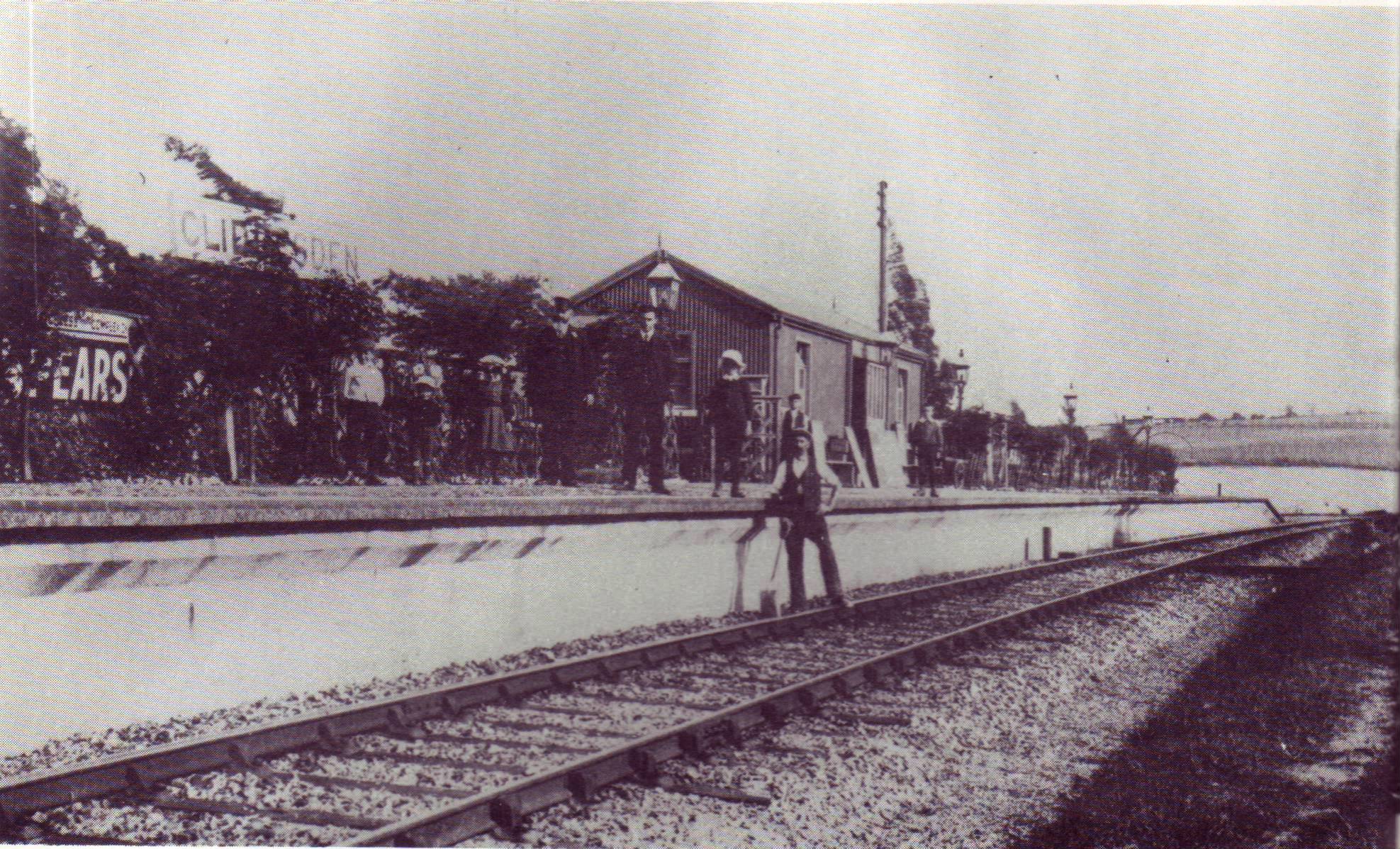
Here's a picture from around 1910 showing the overgrown foliage we based the atmosphere of our scene from. Our model is based around 1916, so the trees have grown considerably compared to the photo.


Ed

Friday, 27 April 2012

Pear's Soap & Lipton's Tea

Take a look at this photo of Cliddesden Station. A sharper image appears in "The Book"*.

The Pear's advertising sign is clearly visible but what do the words say above the Pears name and what colour is the sign? A few letters can be discerned in the book photo but not enough to identify the words. A quick search on the web revealed this image of a near identical sign. It gives us the colour and shows the slogan "Matchless for the complexion". Comparing to the letters we can read in the book it is a match.

Mr. Bushnell (Station Master) is obscuring a second sign that can be seen in the book. The first letter is S and the second and third could be UN. Unfortunately I have not identified this sign. It could be Sunlight Soap but it does not match the style of sunlight adverts and I doubt two competitor products would appear on the same fence.

I'd like to put a sign there so, a look at Bentworth & Lasham in the book shows a Lipton's Tea sign. This time some words of the slogan can be read, being 'sales in the world'. Another search on the web completed the slogan for me as "Largest sales in the world" and the colour scheme is white on green.

These searches also revealed the signs date back to about 1910, which correlates with the L&SWR period photos in the book and the layout we are building.

Both model signs were created in MS Word but the font size could not be set small enough for 'n' gauge. Fortunately, my printer can scale. A transparent plastic film was stuck to the signs to represent the shiny enamel finish.

After all that research the slogans on the models can only be read with the aid of a magnifying glass!


David


* The Basingstoke & Alton Light Railway" Martin Dean et al.

Wednesday, 11 April 2012

More DIY 2mm scale people

Early in 1916 the Women's National Land Service Corps was formed to work on the land because most men were away fighting the war in Europe. This was a small voluntary force of women that later became the Women's Land Army in 1917. The Women's Land Army wore a recognisable uniform whereas the Women's National Land Service Corps were only provided with a beige arm band.

In this scene three volunteers are following the reaper during harvest to make the wheat stooks. This period video shows very well how it was done. One women is aligning the bundles, another has picked up two bundles and waits for the third who is about to pick up another and together they will make the stook. Their clothing is representative of 1916 being plain colours of black brown, beige and white. Styles are based on those seen in this video.
---------------------------------------------------------------------------------------------------------------

Here is Mr. Charles Bushnell, who was the Cliddesden Station Master throughout the LSWR period of the line.

He is in the uniform of the period wearing a frock coat and cap. Note the gold braid and badge on his cap and his characteristic grey beard.

For information on how these models are made see Part 1. However, models shown in this posting differ in so far as they have properly formed shoes, made like the hands, and one shoe has an extended wire for fixing the model into the ground. 0.5mm wire is used for the women's legs instead of 0.7mm.

David

Tuesday, 10 April 2012

Lunchbox Controller

With low cost in mind this handy lunchbox (£0.60) contains the home made circuits for turnout control and power control. Turnout control is uncomplicated with two push button switches (cheaper than toggles) for each turnout. Interlocking and route indicators are not installed.

On the side is the locomotive power control knob and direction switch. Cables exit the rear with a long umbilical plugging into the baseboard, thus enabling the operator to move around all sides of the layout with lunchbox in hand!  Two power leads also connect at the rear for the 15V (turnout control) and 9v (power control) DC bricks.

The big round button on top is in fact the top of a power transistor for the turnout circuit that did not quite fit in the depth of the box.

This compact arrangement is comfortable, dare I say ergonomic, to handle in operation.(No room for sandwiches though).

David