Sunday, 11 November 2012

Remembrance

Watching the excellent docu-drama 'The Somme' on More4 TV channel last night reminded about the immense human sacrifices made during that first world war battle. With a largely untested and volunteer army contingent from Britain it beggars belief the courage required to walk across no mans land towards a hail of bullets taking out comrades walking alongside. The strategy of the commanders whilst devised with good intent was portrayed as a flawed plan causing unnecessary human suffering.

Our model railway is set in August 1916. One month after the battle commenced and here we have a peaceful rural scene (blog header) almost oblivious to the events of war. It makes our creative effort seem frivolous by comparison. But think again because much of the bad things going on abroad was not widely reported. Whilst creating this rural scene in the heart of the English countryside we were vaguely aware of a war in progress elsewhere but probably like the people living at home in the time not fully in tune with the horror of it. It was only when families and communities learnt of the massive losses in The Somme that a sense of shock and realisation pervaded the nation. 

A reminder that life is not quite normal on our model railway is the Women's National Land Service Corps assisting with the harvest, covering for the men sent overseas. Other influences on home life at this time were the requisition of horses for use in the war. Our farmer here is fortunate to still have two horses to pull his reaper. Some farmers were only allowed one horse for the entire farm. Later in 1917 with the U boats decimating the Atlantic convoys spare land was given over to allotments and agriculture to boost home food production. Not a big impact here yet but plenty of unused land available around the station complex.

David

Monday, 5 November 2012

Photograph Series - Part 1

N gauge Model Railway. Basingstoke to Alton Railway - Cliddesden Station 1916


In a new series of landscape photographs showing the (nearly) finished (is it ever finished) model.

Everything you see in the photo, apart from the sky and smoke from the engine, is all "real" and part of the model railway, mostly scratch built and scaled in n-gauge; (approx)2mm:1ft.

Here we see the LSWR O2 (M7 in our case as no r.t.r), leaving Cliddesden station with LSWR 48' Brake Lav. Tri-Comp. I suspect very few people are on-board  It's 1916, war has started, and the line is about to close.

Shot with a Canon EOS 550D.

Ed

Sunday, 28 October 2012

Raising The Bar

With the scenic details finished the question is what next? Well, we can correct errors, add details and cameo scenes almost at infinitum.

Extra details on a small layout sustain visitors viewing interest and it is heart warming for us to hear returning visitors say "Is that new?", when in fact a small detail they spotted had always been there! However, we should not over do it to the point where realism is compromised or it looks cluttered.

There is one scene we have not presented in this Blog so far that has been there from the early days and that is the railway staff cricket pitch. This has its own story based on fact but that will have to wait for another day to be told.

Some new details being discussed include more wild flowers, scratch built LSWR rolling stock, a train conveying Thornycroft J class trucks destined for France in WW1 (although whether or not they came this way is questionable, despite the factory being just up the line) and to move the layout forward 8 years to depict the station and rolling stock in Southern Railway livery. If we were starting again we would make the station platform and its tree line a replaceable module so that a SR version could be swapped in. Things that would be different include taller trees, SR station name boards, wire fence, SR staff and more vegetation. Currently, only the station building can be easily swapped for a SR green version.

One error that has just been corrected is the level crossing gate that was made too low and depicted 5 bars instead of 6. But, studying the real Cliddesden gate since remaking the model I noted it has 7 bars! I have seen pictures of other LSWR gates with 6 bars so, I'll not be changing it again. At least the height looks correct.

Spot the Difference

David

Wednesday, 24 October 2012

Ladders

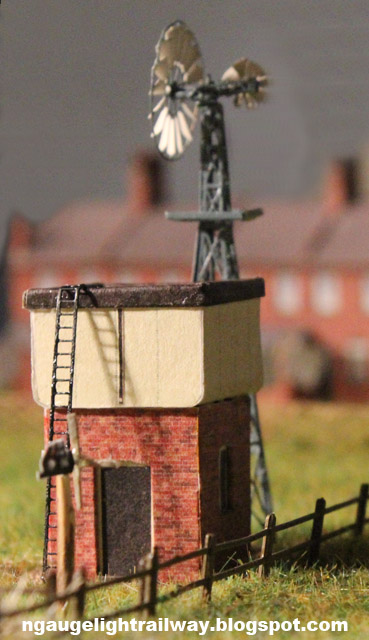
A few more realistic details added to the model... In this case adding a few ladders in appropriate factual locations, according to photos in "The Book". The most obvious one was adding a ladder to the water tower, it was quite interesting to pick up the detail of the shadow generated by it on our model. A less obvious place where a ladder was spotted in one of the photos was, a step ladder propped up against the wall of the station building, behind the open gate (can you see it).


We used scalelink's n gauge ladder brass fret, painted hambro black. It's supplied as a set of 6, so we got to think of some more realistic interesting places to put the rest.

Ed

Monday, 22 October 2012

n Gauge Loco Crew

It's bad enough that our little engine does not emit smoke and steam but to be conveying passengers and goods without a footplate crew is down right inexcusable!

I selected the loco crew from the FLEETLINE range. This is very good value for money as we get two sets of people in 4 different poses. Some photos from LSWR days show the driver wearing a protective over jacket, which I believe to be a very light blue.


We wanted the crew to be removable from the cab because there is a crazy idea of fitting a DCC chip at some point and we wondered if the cab void would be needed for it. So, the solution was to fix the crew to a thin piece of brass such that the assembly could be slid into the cab between the hand rails and held in place with double sided tape. This can be prised out without too much difficulty.

Virtually impossible to discern any detail of the crew once installed so if the pose or position of them is wrong then it don't matter. At least it is obvious the footplate is now occupied.


To finish the loco fittings diamond route indicator boards were fitted to the front. These are pieces of double sided tape with the protective layer retained. The sticky side holds it to the body. A bit fragile but wanted to be able to remove them without damaging the loco in the future, if necessary.


I'd lke to know what year diamonds were changed to circles.

David

Sunday, 21 October 2012

The Alton Spur

The Basingstoke Station, in N gauge, was on show at the 38th Farnham Expo. This was off interest to us, as it's our local mainline station and it's one end of where the Basingstoke and Alton light railway terminated. As the model is set in the 1960's the Basingstoke and Alton line had long gone, but here we see the line where it got cut off (on the far left hand side). Read more about the expo here

Next passenger stop would have been Cliddesden, after passing the Thornycroft car factory which was also connected to the Basingstoke and Alton line.

Ed

Friday, 19 October 2012

LSWR Brake Van Part 5

Shock, horror and panic over.

Having coupled the Brake Van on to its train I noticed that the height of it was a good deal less than other box vans. Had I got the height wrong somehow? Checking the dimensions with the drawing revealed it to be correct.

Happily, there is a photo in the magazine of a prototype Brake Van coupled to a standard 10 ton SR box van and indeed the Brake Van is a bit of a squat.

The photo below shows the complete train from the normal the viewing distance. You may wonder why there are GW trucks in LSWR territory. Well the movement of goods between territories resulted in such events and the foreigners were often held and used for local deliveries eventually finding there way back to home ground. The other reason of course is a lack of LSWR r-t-r trucks from the trade!


Might be worth mentioning that the limit on train length for this line was initially set at ten loaded wagons (or 15 empty wagons) and three 4 wheeled passenger coaches. I wonder if a mixed train of this length every worked the line since it was a quiet back water with little traffic demand.


David